
I is for Icebreakers
 Perhaps this newsletter should be called I is for ‘if’ because this is what has been going on in my head for the last few months. If I write about this subject I can use these examples or if I write about that subject I can write about those examples. If you knew how many times I’d sat down to write this newsletter, you’d laugh. In the end, I’ve stopped procrastinating and ‘I is for Icebreakers’
Icebreakers, energisers, openers … whatever you might call them, they’re good to use in our personal lives as well as our professional ones. If you’re anything like our family, we play games whenever we get together. And I’m not just talking about cards or jigsaws but ones that get everyone in the room involved. A favourite is the ‘who am I?’ game. Mum loves sitting with her pad of post-it notes thinking up characters so that she can stick them on our foreheads for us to guess who we are through a number of closed questions. It always gets us laughing as she gives us some obscure ones which really make us think. Still we got our own back earlier this year and it took her ages to reveal her identity, even with a number of nose wrinkling clues, when we cast her as Babe!
As a trainer and facilitator I use a variety of icebreakers and energisers on a regular basis. Whether it’s at the beginning of the session or part way through the day, games are a great way to instil energy in the room and get people buoyed up again. If you have a short warm up that relates to your topic, you’re bound to get your group re-engaged. I’m sure we’ve all been in the situation when you’ve come back from lunch and everyone is feeling a little lethargic … we might not want to play a game, but by the end of it, we’re all laughing and joking and our energy levels have increased again because laughter pumps energy through the body and wakes us up.
So when else might you use an icebreaker or a game. I tend to use them in one of five situations. For introductions, setting the scene, energising a group, team building or to get people talking at a party!
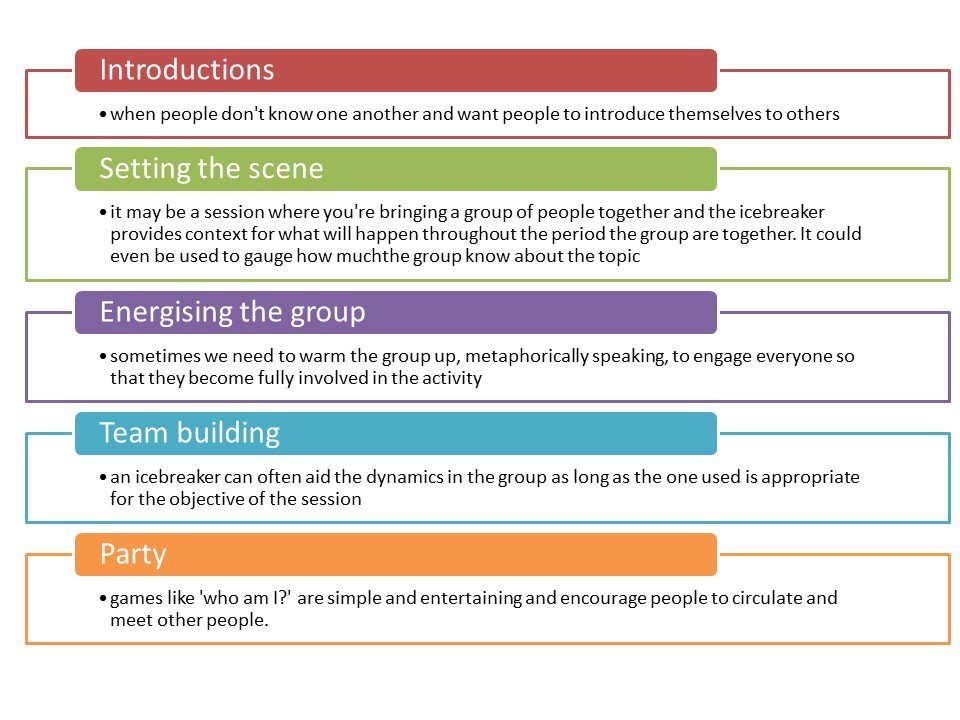 If I facilitate a session for a group of people, I often use an icebreaker to get everyone talking. Even if the group know each other well they may feel a little anxious about working together on a new topic or project. This is especially helpful if groups have already formed into their cliques as you can form random groups in a fun and non-threatening way. If you have a group of people who are all contributing to the objective of the session you are more likely to get a positive outcome. And because we all learn differently, games offer an opportunity to help people with their own learning styles. We might see someone do something different in play to what they might do in the work place and this is usually because they feel less inhibited to try something new when they’re having fun.
I was recently reading a blog called 100 icebreakers for talks with strangers. It was a Q&A with author Davy Rothbart who had been researching the types of questions that bring people closer together and in so doing create a greater connection. His number one question was – if you could ask a stranger any question, what would it be? As you can imagine he certainly received a diverse set of answers. However what he found was that people with drastically different backgrounds seemed to be curious about similar types of issues. He’s now written a new TED Book called ‘How did you end up here?’ The surprising ways our questions connect us. I’ll let you know what it’s like when I’ve read it, but in the meantime, you may want to have a read of the blog as it’s really interesting.
So, if you’ve got a session coming up and need to help people to relax and open up, think about doing some type of icebreaker. I’m happy to share some of the ones that I’ve collected over the years, likewise if you have some that you think I’d like, please do get in touch at jane@janehirst.com.
Last year we played Jenga at a friend’s party and everyone really enjoyed it. I now use this as one of my games in work to help teams to think about risk taking, problem solving and communication skills. What I’ve found is where there is increased engagement there is always more learning. When people are talking, laughing and having fun, they much more likely to reach out of their comfort zones and try something new.