
J is for Jargon
 In the last couple of months there have been a number of times when I’ve wanted to laugh out loud at words or phrases that people have used. For instance when I was helping a friend at her stand at the Olympia Exhibition centre earlier this month, a lady came up raving about our product and services; so much so that she called one of her colleagues to come and look at the stand as well. However, when my associate went to ask if he could help, she turned around to him and said that she was an approacher and if she wanted any help she’d ask for it and turned on her heel and departed! An approacher? Have you ever heard of that phrase? No I hadn’t either, but now that I have, I’ve made a mental note not to use it in the future!!
As jargon seems to find its way into all sorts of places, I thought I’d focus on it for the letter of J this month. Jargon … that wonderful word used for people who are talking in gibberish or at least in a way that is unintelligible to some of the people around them. When I’ve researched it more, I’ve found it described as
‘a special language concerned with a particular subject, culture or profession who use it as part of their everyday life. It may be words or abbreviations’.
How many times have you been into an organisation to find it full of TLAs??? That is of course the Three Letter Acronym. When I was at Mortgage Express, we had so many TLAs that I asked one of our new graduates to put together a glossary of terms together for them. It populated a number of pages and highlighted a couple of things to us. Firstly how much we relied on these letters as a type of professional shorthand. It was much more convenient and created a more efficient way of working. Secondly, how it was essential that we really knew the meaning of each acronym so that we could fully describe what we meant to our customers or people who weren’t working in our sector.
As you know, six months after leaving Mortgage Express I set up my own business. I didn’t think I used any jargon when speaking to people. I’d studied with the Plain English Campaign and was proud of the work we’d done in the organisation to simplify the way in which we communicated to our customers with the intent of being understood first time, every time. However, here I was in my new world as a consultant no longer working with large corporates but small and medium sized businesses. It wasn’t long before I realised that my language wasn’t that clear at all! Having been employed in a big organisation for a large part of my life, I had adopted the way corporates speak and it wasn’t until I saw the screen savers come down over people’s eyes that I realised that I they didn’t know what I was talking about!
This was both a shock and an eye opener to me. In the past, I’d been the person who had taken the mickey out of others when they said things like ‘you need to get all your ducks in a line’ or ‘let’s have some blue sky thinking’. In fact those of you who are old enough might even recognise the bingo card below that we used to have when people started talking jibberish at meetings!

Like everything, those words may not be as popular as they once were. When I looked up the latest business jargon, there are words like:
- Holacracy – companies that shun top down hierarchies and believe in management by committee
- VUCA – used to describe the type of world we currently live in – volatile, uncertain, complex and ambiguous
- 20% time – made famous by Google who allow their employees to spend 20% of their working time doing projects they are passionate about
- Gamification – games and competitions that make technology more interesting and engaging.
When the BBC published a report last year about business jargon it received 330 comments in a very short period of time as to whether jargon in business was beneficial or counterproductive. Having read the comments, they reiterate that jargon (or slang) brings a people together as it reinforces belonging to a certain group.
At the end of the day, I don’t think jargon should be categorised as either good or bad because it does have its place. The key is to decide whether it is appropriate. Think of your audience. Will they know what you are talking about? I was recently working with a group of people in a global pharmaceutical company where we were discussing the use of plain English terms in our session about ‘getting the most out of your written communication’. As they write in English to their customers worldwide it is important to use words that translate easily into the various languages to which they are translated. From a translator’s point of view, the presence of jargon in a text may help to identify the intentions of the author. However in a different situation the presence of jargon may be inappropriate and should be avoided. My litmus test is my mum. If she glazes over when I’m trying to describe something to her, I change the words.
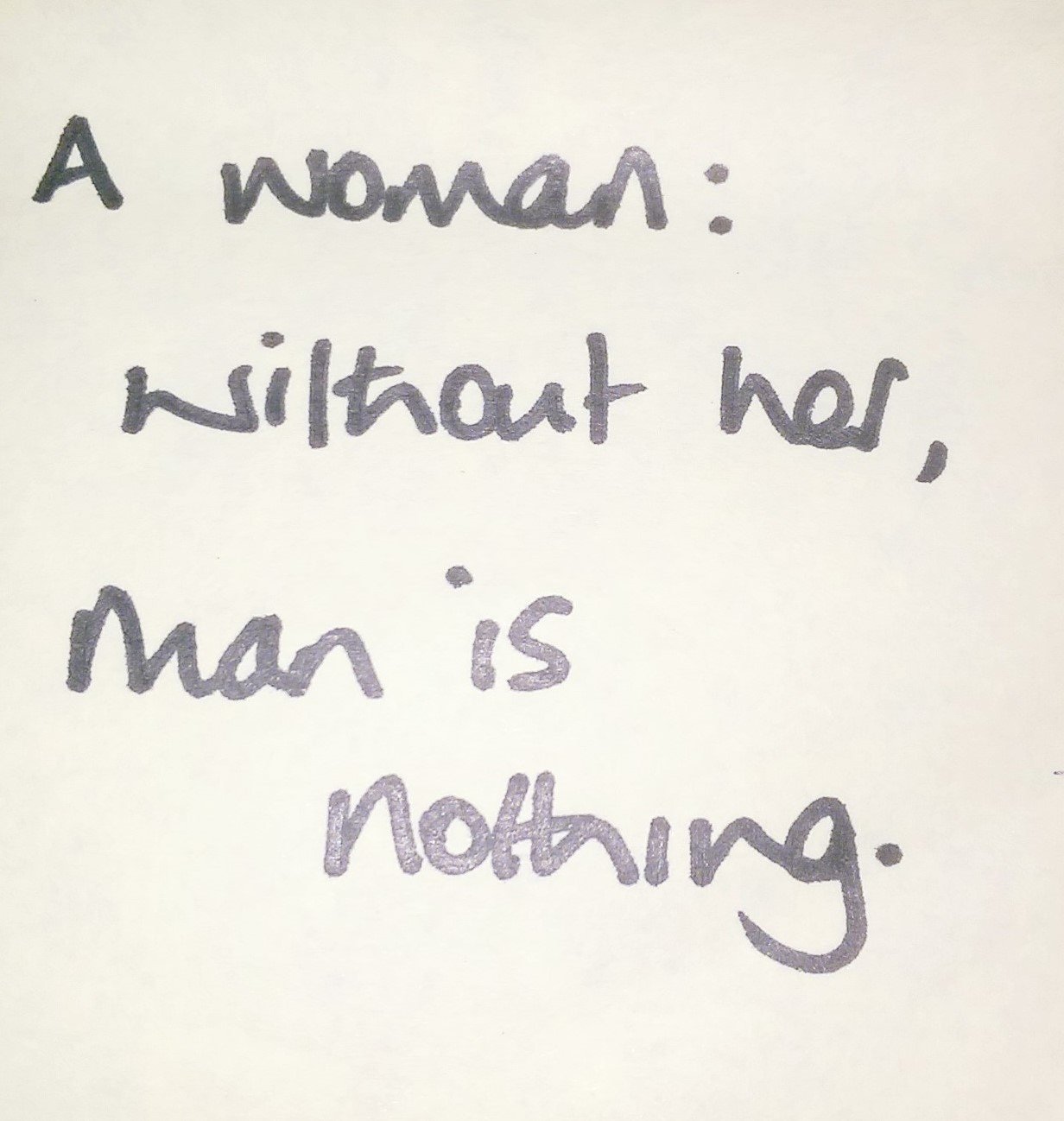
To finish on a couple of lighter notes, I thought I’d share this sentence that I saw when I was travelling on the tube a couple of days. It said:
A woman without her man is nothing
Where would you put the punctuation? Have a look at how the sentence can alter dependent on where you put it for example

And as we’re getting you thinking why don’t you have a read through the following paragraph. Cut through the jargon and see if you can answer the two questions below.
A ‘research team’ proceeded towards the apex of a natural geological protuberance. The purpose of their expedition – the procurement of a sample of fluid hydride of oxygen in a large vessel, the exact size of which was unspecified. One member of the team precipitately descended sustaining severe fractural damage to the upper cranial portion of his anatomical structure. Subsequently, the second member of the team performed a self-rotational translation orientated in the direction taken by the first member.
How many are in the team and what are their names?
I’d love to hear from you and get your views on jargon. Until the next time, let me leave you with a quote that I felt was very apt for this month’s subject. This one is by William Butler Yeats and I think very relevant to this month’s topic –
‘Think like a wise man but communicate in the language of the people’.